Dr. Chnristensen received his Ph.D in Chemical Oceanography from the University of Washington (Christensen, J.P., 1981, Oxygen consumption, denitrification, and sulfate reduction in coastal marine sediments. University of Washington, Seattle, 231 pp.). Since then, he has conducted laboratory and field research on a variety of topics:
Marine sediments are an important site where organic matter, falling down through the water column, is decomposed. In utilizing this organic material, the biological communities release the constituents of the organic matter back into the sediment pore waters, and from there, back into the waters above the sediments. In addition, these communities consume key oxidants which are supplied from the overlying waters, including dissolved oxygen, inorganic nitrate, and sulfate ions, and as a result, these solutes typically become depleted within the sediments so that the sediments are a net sink for these types of compounds.
Some of Dr. Christensen's papers about these processes are:
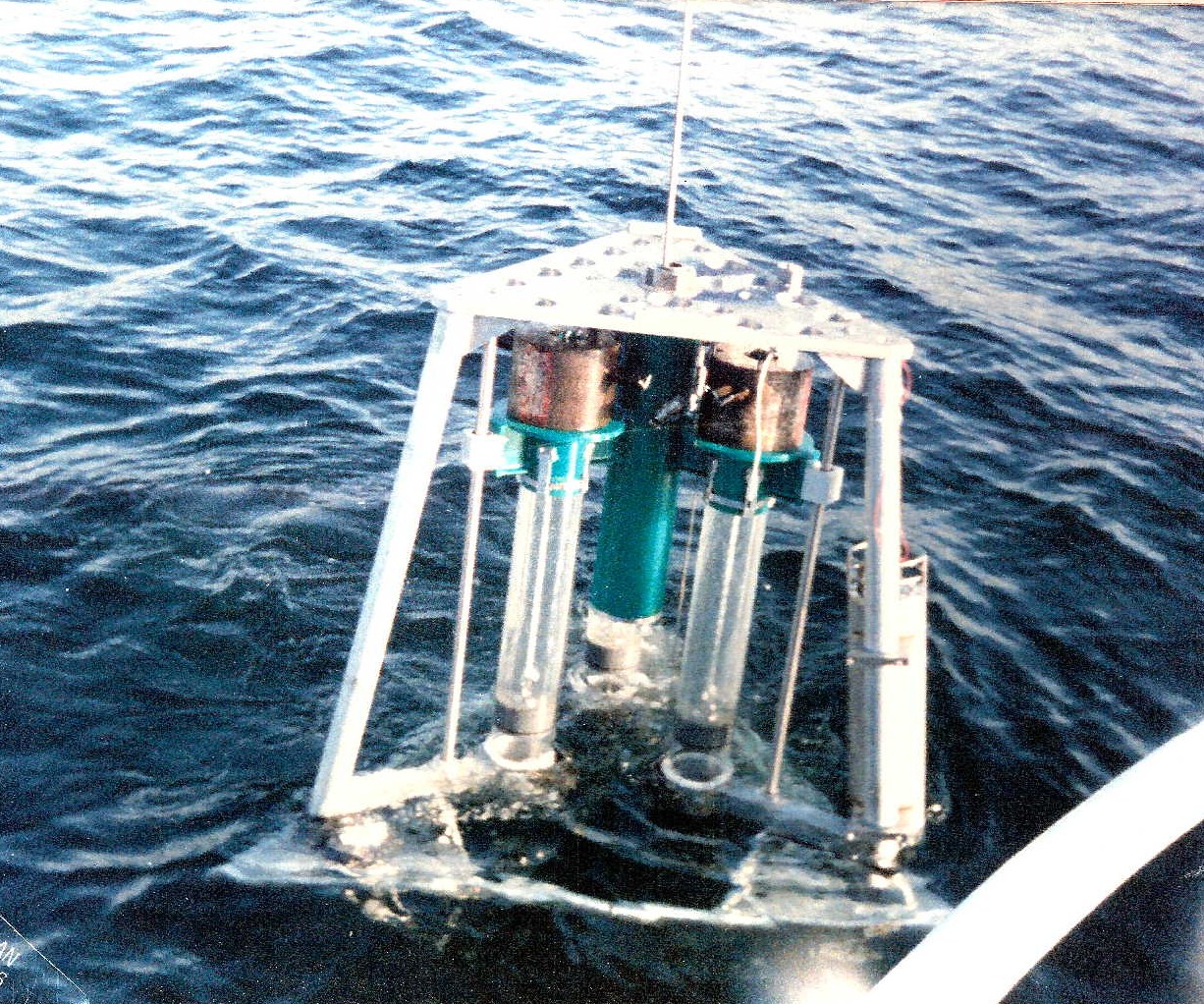
A multiple corer beginning its descent to collect triplicate cores from the deep continental shelf off Maine. (photo by J.P. Christensen).
2008 Christensen, J.P. Sedimentary carbon oxidation and denitrification on the shelf and slope of the Alaskan Beaufort and Chukchi Seas. Open Oceanography Journal, 2, 6-17.
2000 Christensen, J.P. A relationship between deep-sea benthic oxygen demand and global primary productivity. Oceanologica Acta 23: 65-82
1997 A.H. Devol, L.A. Codispoti, Christensen, J.P. Summer and winter denitrification rates in Arctic shelf sediments. Cont. Shelf Res. 17: 1029-1050.
1993 Devol, A.H., J.P. Christensen. Benthic fluxes and nitrogen cycling in sediments of the continental margin of the eastern North Pacific. J. Mar. Res. 51: 345-372.
1989 Christensen, J.P. Sulfate reduction and carbon oxidation rates in continental shelf sediments, an examination of off shelf carbon transport. Continental Shelf Res. 9: 223-246.
1984 Christensen, J.P., A.H. Devol, W.H. Smethie, Jr. Biological enhancement of solute exchange between sediments and bottom waters on the Washington continental shelf. Cont. Shelf Res. 3: 9-23.
One of these metabolisms is accentuated in sediments and is globally important, that of nitrate consumption and denitrification. Within a few centimeters of the surface of most sediments, the nitrate concentrations found in overlying waters are completely depleted. This disappearance, denoted as nitrate consumption, may result from nitrate being converted to nitrite, to a variety of slightly oxygenated nitrogenous compounds, to nitrogen gas, or to ammonium. When nitrogen gas is the product, the process is denoted in general as denitrification. Within the sediments, this gas does not enter into other reactions appreciably so escapes to the atmosphere. The process is globally important because sediments and the few anomalous regions in mid-water of continental slope areas (e.g. the north and south Eastern Tropical Pacific and the Arabian Sea) have sufficient rates of conversion of nitrate to nitrogen gas that this balances nearly all nitrogen inputs to the oceans. As a result, the nitrate concentration in the oceans is much less than would be the case if this process did not occur. The process of oceanic denitrification effectively limits oceanic productivity on the thousand to ten-thousand year time scales. Dr. Christensen has several publications on this topic:
2001 Codispoti, L.A., Brandes, J., Christensen, J., Devol, A.H., Nagvi, S.W.A., Paerl, H., Yosinari, T. The oceanic fixed nitrogen and nitrous oxide budgets: Moving targets as we attempt to understand the anthropocene? Scientia Marina, 65 (Supplement 2): 85-105.
1997 A.H. Devol, L.A. Codispoti, Christensen, J.P. Summer and winter denitrification rates in Arctic shelf sediments. Cont. Shelf Res. 17: 1029-1050.
1996 Christensen, J.P., D.W. Townsend, J.P. Montoya. Water column nutrients and sedimentary denitrification in the Gulf of Maine. Cont. Shelf Res. 16: 489-515.
1996 Codispoti, L.A., B. Wheless, P. Becker, J.P. Christensen, A.H. Devol, H.W. Paerl, S.W.A. Naqvi, T. Yoshinari. A revised oceanic combined nitrogen budget and its implications for exchange of carbon dioxide between the atmosphere and ocean. Abstract. Carribean J. Science 32 (3) 284-285.
1994 Christensen, J.P. Carbon export from continental shelves, denitrification, and atmospheric carbon dioxide. Cont. Shelf Res. 14: 547-576.
1987 Christensen, J.P., J.W. Murray, A.H. Devol, L.A. Codispoti. Denitrification in continental shelf sediments has major impact on the oceanic nitrogen budget. Global Biogeochem. Cycles 1: 97-116.
1987 Christensen, J.P., W.H. Smethie, Jr., A.H. Devol. Benthic nutrient regeneration and denitrification on the Washington continental shelf. Deep-Sea Res. 34: 1027-1047.
1985 Codispoti, L.A., J.P. Christensen. Nitrification, denitrification, and nitrous oxide cycling in the eastern tropical South Pacific Ocean. Mar. Chem. 16: 277-300.
The Arctic Ocean is undergoing considerable climatic change. Although its area represents only about 3% of the total ocean area, the Arctic region has about 25% of all continental shelf area within its boundaries and it receives about 10% of the river inputs of fresh water. Dr. Christensen have several publications about this important region:
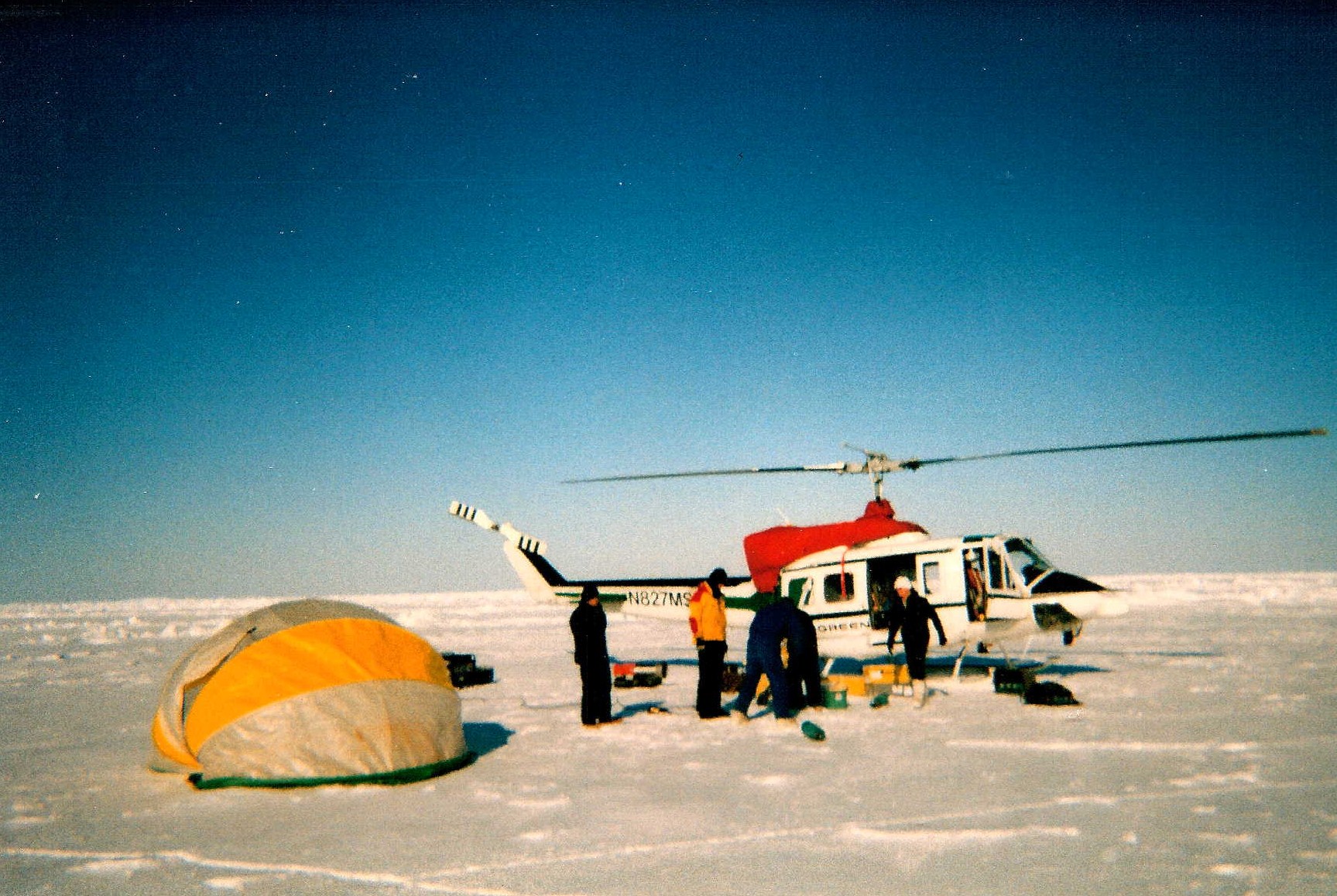
Above: Sampling the ocean waters from sea-ice flows in the continental slope region north of Alaska. (photo by J.P. Christensen).
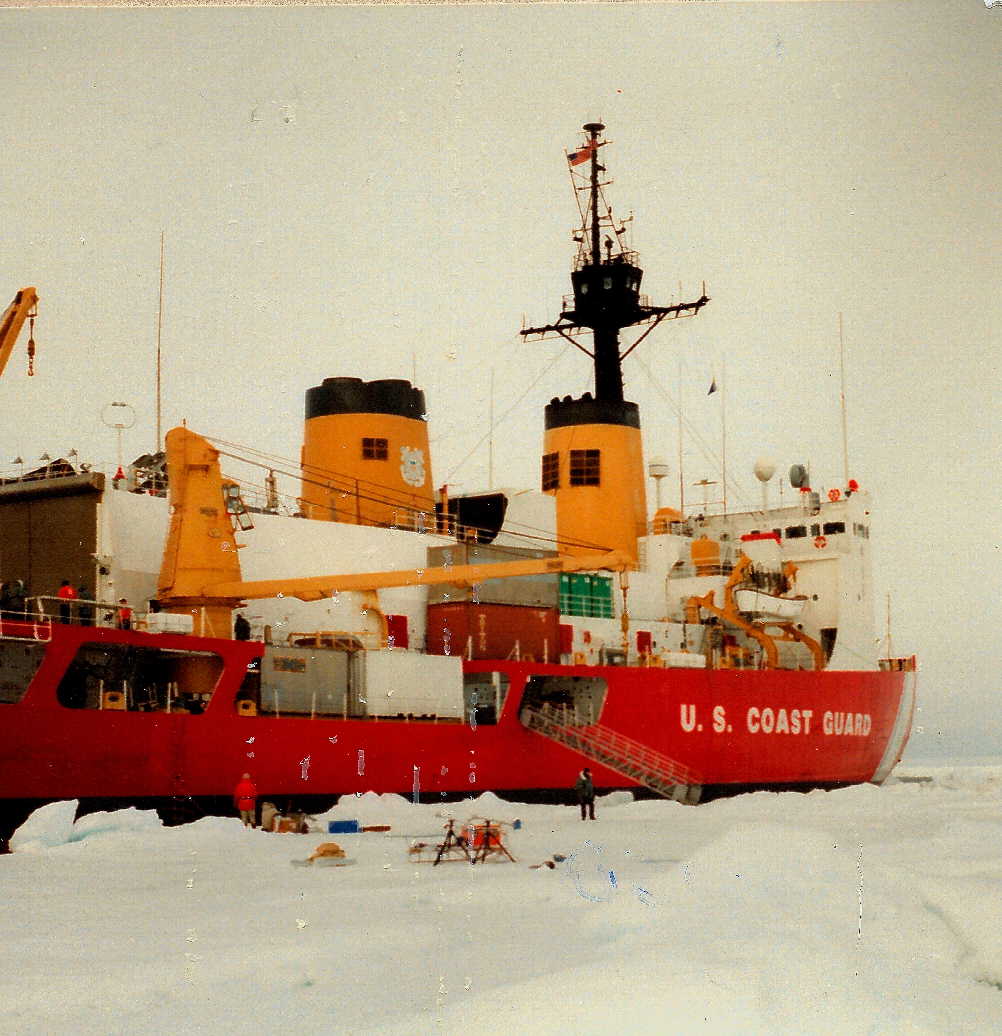
Left: The icebreaker, U.S.C.G Polar Sea, on a rest day near the North Pole. (photo by J.P. Christensen).